HVAC Systems Design Handbook, Fourth Edition
In most HVAC systems, the final energy transport medium is moist air a mixture of dry air and water vapor. This is conveyed through filters, heat exchange equipment, ducts, and various terminal devices to the space to be air-conditioned. The power to move the air is supplied by fans. This chapter discusses fans and duct systems, together with related subjects such as grilles, registers, diffusers, dampers, filters, and noise control.
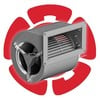
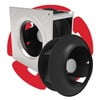
According to Air Moving and Conditioning Association (AMCA) Standard 210,1 A fan is a device for moving air which utilizes a power-driven, rotating impeller. The three fan types of primary interest in HVAC systems are centrifugal, axial, and propeller. The fan motor may be directly connected to the impeller, directly connected through a gearbox, or indirectly connected by means of a belt-drive system.
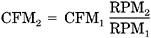
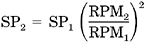
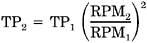
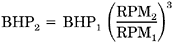
The fan law equations are used to predict the performance of a fan at some other condition than that at which it is tested and rated. The HVAC designer is particularly interested in the effects on horsepower, pressure, and volume consequent to varying the speed of the fan in a system.
The fan laws expressed in the following equations relate only to the effect of varying speed, assuming that fan size and air density remain constant.
| (5.1) | |
| (5.2) | |
| (5.3) | |
| (5.4) | |
where CFM = airflow rate, ft<sup3</sup>/minSP = static pressureTP = total pressureBHP = brake horsepower, bhp
Expressed in simple language, the fan laws say that when fan size and air density...