IC Layout Basics: A Practical Guide

This book teaches the basics of IC (Integrated Circuit) layout in jargon-free, plain-English, understandable to those without an EE degree.
 TABLE OF CONTENTS
 Once you learn to calculate resistance values, you will be better able to understand and control your circuit, thereby avoiding errors before the chip is built. This is a primary reason why some layout designers' chips tend to always work the first time. It's a valuable tool. Let's start with a few basic concepts about measurement.
Let me show you one of the easiest methods to calculate resistance value.
Integrated Circuit (IC) chips contain many types of materials such as polysilicon, oxide, various diffusions of basic CMOS transistors, and metal. A popular resistor material is polysilicon, also known as poly. We'll refer to poly often for examples in this book. Typically, all chip materials, including poly, are made in thin sheets.
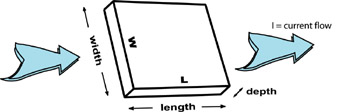
Let's assume that we pass a current through a sheet of polysilicon, as shown in the diagram. If the sheet were thick, there would be more room for current to flow. Therefore, a thicker chunk would have a lower resistance value.
If it were very thin, it would have less ability to carry current, because there is less room for the current to flow through the material. Therefore, thinner sheets have higher resistance values. Other factors, such as type of material, length, and width also change resistive values.
These values of resistance are...