IC Layout Basics: A Practical Guide

This book teaches the basics of IC (Integrated Circuit) layout in jargon-free, plain-English, understandable to those without an EE degree.
 TABLE OF CONTENTS
 You have just seen why resistance material is measured in ohms-per-square, also known as sheet rho. Now we will use a poly resistor to understand the different parts of the complete resistance equation for a real world IC resistor. You will notice that many elements of the formula are given in the ohms-per-square units we just learned.
Let's follow the manufacturing process involved in making a polysilicon resistor, in order to understand all the components.
The substrate material is the bottom layer of raw silicon. On the substrate, we deposit a poly layer, which we will use to resist electrical flow.
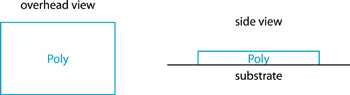
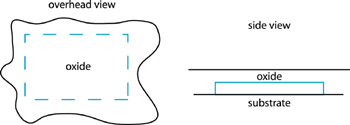
We need to connect our bits of poly material somehow into the path of electrical flow. So, on top of the poly layer we lay down an oxide layer. This good insulator will protect further layers from contacting the poly in unwanted places.
Then we can etch through the oxide, making contact holes. These holes dig through to the poly in exact locations just where we want to make contact with the poly. Hence the name contact holes.
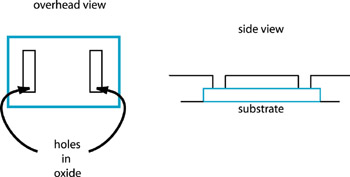
We deposit some metal into these etched holes. The metal fills the contact hole, contacting the poly. In the diagram, you will notice one etched contact hole at one end of the poly...