IC Layout Basics: A Practical Guide

This book teaches the basics of IC (Integrated Circuit) layout in jargon-free, plain-English, understandable to those without an EE degree.
 TABLE OF CONTENTS
 A capacitor is a device that stores charge.
You can make a capacitor for yourself. Use two sheets of tin foil. Separate them with a layer of plastic food wrap. There you go. Instant capacitor.
One of the tricks my physics teacher used to do is get some really big capacitors, charge them up, and be very obvious about disconnecting the battery. Then just before he left the room, he'd say "Now nobody touch these!"
And, of course, some of the more curious kids would say, "Hmmm, I wonder what that is." They'd pick up these things, start playing with them and get a huge zap out of this capacitor. He'd charge them up to 500 V or so.
That was before the days of lawsuits. But it did demonstrate that a capacitor stores its charge, so it served its purpose.
He could tell who'd done it when he returned to the room by finding the person with their hair standing on end.
Do not try this yourself. It is extremely dangerous
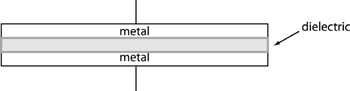
A capacitor is a device that has the capacity to store a certain amount of charge, a certain number of electrons. The ability of a capacitor to store charge is called capacitance. The measurement unit for capacitance is farads. A capacitor is built from two conducting plates separated by an insulating material called the dielectric. It is in this dielectric where the charge is stored.