Introduction to 3G Mobile Communications
In this chapter some basic concepts of CDMA are discussed. These concepts are CDMA specific, and often not used in other technologies, so some explanation may be necessary. An understanding of these concepts will make reading this book much easier. The examples in this section are wideband CDMA (WCDMA) specific.
The radio spectrum is a scarce resource. Its usage must be carefully controlled. Mobile cellular systems use various techniques to allow multiple users to access the same radio spectrum at the same time. In fact, many systems employ several techniques simultaneously. This section introduces four such techniques:
Frequency-division multiple access (FDMA);
Time-division multiple access (TDMA);
Code-division multiple access (CDMA);
Space-division multiple access (SDMA).
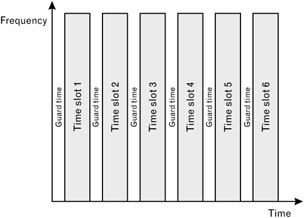
An FDMA system divides the spectrum available into several frequency channels (Figure 2.1). Each user is allocated two channels, one for uplink and another for downlink communication. This allocation is exclusive; no other user is allocated the same channels at the same time. In a TDMA system (Figure 2.2), the entire available bandwidth is used by one user, but only for short periods at a time. The frequency channel is divided into time slots, and these are periodically allocated to the same user. Separate time slots are needed for the uplink and the downlink.
GSM is based on TDMA technology. In GSM, each frequency channel is divided into several time slots (eight per radio frame), and each user is allocated one (or more) slot(s). In a TDMA...