Introduction to 3G Mobile Communications
Chapter 4: Modulation Techniques and Spread Spectrum

4.1 Spreading Techniques

There are several techniques employed for spreading the information signal. Below, the most important ones are discussed, although these are by no means the only ones, and in addition these techniques can be combined to form hybrid techniques. The UTRAN uses the DS-CDMA modulation technique.

4.1.1 Direct-Sequence CDMA

In direct-sequence spread spectrum (DS-CDMA) the original signal is multiplied directly by a faster-rate spreading code (Figure 4.1). The resulting signal then modulates the digital wideband carrier. The chip rate of the code signal must be much higher than the bit rate of the information signal. The receiver despreads the signal using the same code. It has to be able to synchronize the received signal with the locally generated code, otherwise the original signal cannot be recovered.


Figure 4.1: Direct-sequence CDMA principle.

4.1.2 Frequency-Hopping CDMA

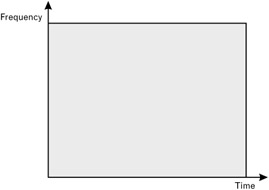
In frequency-hopping spread spectrum, the carrier frequency at which the signal is transmitted is changed rapidly according to the spreading code. FH systems use only a small part of the bandwidth at a time, but the location of this part changes according to the spreading code (Figure 4.2). The receiver uses the same code to convert the received signal back to the original. Frequency-hopping CDMA systems can be further divided into slow- and fast-hopping systems. In a slow frequency-hopping system, several symbols are transmitted on the same frequency, whereas in fast hopping, the frequency changes several times during the transmission of one symbol. The GSM system is an example of a slow FH (frequency...

UNLIMITED FREE
ACCESS
TO THE WORLD'S BEST IDEAS

SUBMIT
Already a GlobalSpec user? Log in.

This is embarrasing...

An error occurred while processing the form. Please try again in a few minutes.

Customize Your GlobalSpec Experience

Category: RF Receivers
Finish!
Privacy Policy

This is embarrasing...

An error occurred while processing the form. Please try again in a few minutes.