Introduction to 3G Mobile Communications

7.2: Control Plane

7.2 Control Plane

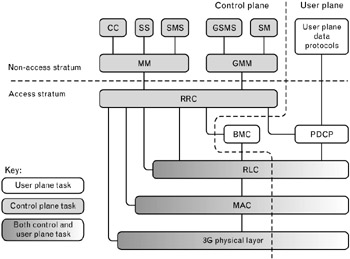
Radio interface protocols can be divided into two categories: horizontal layers and vertical planes (Figure 7.2).


Figure 7.2: Protocol tasks in the UTRAN air interface.

There are three protocol layers in the AS: physical layer (L1), data link layer (L2), and network layer (L3). The data link layer can be further divided into several sublayers: medium access control (MAC), radio link control (RLC), broadcast/multicast control (BMC), and packet data convergence protocol (PDCP). The network layer also includes several sublayers, but among these only the radio resource control (RRC) belongs to the AS. The other sublayers within the network layer are part of the NAS (CN) protocols.

There are also two vertical planes; the control (C-) and user (U-) planes. The MAC and RLC layers exist in both the C- and U-planes. The RRC is found only in the C-plane (i.e., RRC=Radio Resource Control), and the BMC and PDCP are found only in the U-plane.

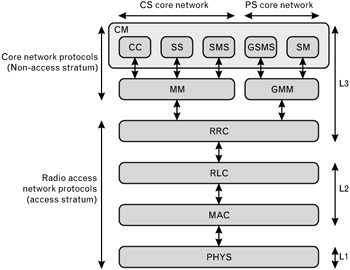
All of these aspects are explained in subsequent chapters: first the C-plane (Figure 7.3), and then the U-plane protocols. The RRC gets the most thorough treatment in this book, because it also manages the other protocol layers in the AS. Understanding the RRC is an essential prerequisite to understanding the air interface's inner workings.


Figure 7.3: WCDMA C-plane protocol stack.

In the following sections, try to notice the difference between the concepts of function and service. A function is something a protocol does for itself. This may require...

UNLIMITED FREE
ACCESS
TO THE WORLD'S BEST IDEAS

SUBMIT
Already a GlobalSpec user? Log in.

This is embarrasing...

An error occurred while processing the form. Please try again in a few minutes.

Customize Your GlobalSpec Experience

Category: Protocol Stack Software
Finish!
Privacy Policy

This is embarrasing...

An error occurred while processing the form. Please try again in a few minutes.