Introduction to 3G Mobile Communications
A modern telecommunication network such as UMTS can provide a wide variety of services. The service concepts and definitions of UMTS are for the most part copied from the GSM world. But whereas in GSM the service parameters are often fixed, in UMTS they can be dynamically renegotiated whenever required.
The services provided by UMTS can be divided into four main classes:
Teleservices;
Bearer services;
Supplementary services;
Service capabilities (i.e., support for value-added services).
Each is discussed, one-by-one, in the following sections.
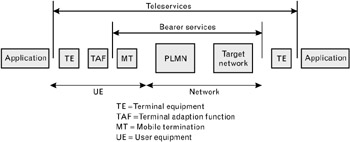
A teleservice is a type of telecommunication service that provides the complete end-to-end capability for communication between mobile users in accordance with standardized protocols. The user has no direct responsibility for the end-point applications in a teleservice. Contrast getting your e-mail over a GSM handset attached to a laptop (a bearer service) with simply talking on a GSM phone (a teleservice). Tele-services make use of the whole OSI model protocol stack (except for a layered protocol between them), and they also include the terminal equipment functions. The difference between teleservices and bearer services is depicted in Figure 13.1. Teleservices utilize the bearer services provided by the lower layers (except for circuit-switched speech services).
Teleservices and bearer services must be decoupled. It is not good to map bearer services and teleservices to each other, as changes to one component require changes to the other.
Some teleservices need to be standardized so that they can inter-work with corresponding teleservices provided...