Introduction to 3G Mobile Communications

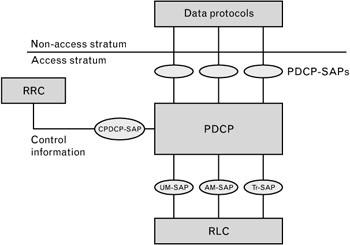
As the name implies, the PDCP task is a convergence layer between the actual data protocol in the NAS and the radio access protocols in layer 2 (Figure 7.26). The PDCP itself is an AS protocol. This protocol entity is only used in the U-plane. The required control signaling for the PDCP is handled by the RRC. The PDCP handles the same functionality in the UTRAN as the SNDCP task does in the GPRS system.
The network layer in the NAS can accommodate several different data protocols. These current (and future) protocols must be transferred transparently over the UTRAN. This is the task of the PDCP, which must hide the particularities of each protocol from the UTRAN. The packets from all of these protocols will be conveyed over the UTRAN without any changes to the UTRAN protocols.
Therefore the functions the PDCP shall perform include:
Header compression and decompression of IP data streams;
Transfer of user data;
Forwarding of PDCP SDUs and associated PDCP sequence numbering;
Multiplexing of different RBs onto the same RLC entity.
Header compression and decompression are performed by the PDCP to optimize the channel efficiency in the radio interface. The network data protocols are not especially designed for wireless environments, and thus they may have unnecessarily large header fields in their data packets. It is the task of the PDCP to compress these headers to more compact representations. Each data protocol has its own header format, so...