Introduction to Applied Statistical Signal Analysis: Guide to Biomedical and Electrical Engineering Applications, Third Edition
4.3: Joint Probability

4.3 Joint Probability

4.3.1 Bivariate Distributions

The concept of joint probability is a very important one in signal analysis. Very often the values of two variables from the same or different sets of measurements are being compared or studied and a two-dimensional sample space exists. The joint or bivariate probability density function and its moments are the basis for describing any interrelationships or dependencies between the two variables. A simple example is the selection of a resistor from a box of resistors. The random variables are the resistance, r, and wattage, w. If a resistor is selected, it is desired to know the probabilities associated with ranges of resistance and wattage values, that is

(4.19)

where R and W are particular values of resistance and wattage, respectively. For signals this concept is extended to describe the relationship between values of a process x( t) at two different times, t 1 and t 2, and between values of two continuous processes, x( t) and y( t), at different times. These probabilities are written as

(4.20)

respectively. The joint probabilities are functionally described by bivariate probability distribution and density functions. The bivariate cdf is

(4.21)

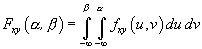
It is related to the bivariate pdf through the double integration

(4.22)

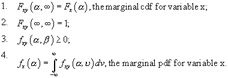
These functions have some important properties. These are

(4.23)

Again, when there is no confusion concerning the random variable and its specific values, a simpler notation is often utilized.

UNLIMITED FREE
ACCESS
TO THE WORLD'S BEST IDEAS

SUBMIT
Already a GlobalSpec user? Log in.

This is embarrasing...

An error occurred while processing the form. Please try again in a few minutes.

Customize Your GlobalSpec Experience

Category: Strip Heaters
Finish!
Privacy Policy

This is embarrasing...

An error occurred while processing the form. Please try again in a few minutes.