Introduction to Applied Statistical Signal Analysis: Guide to Biomedical and Electrical Engineering Applications, Third Edition
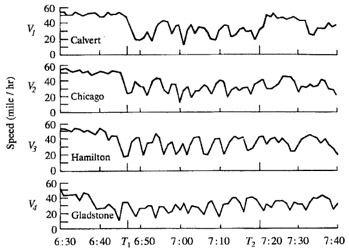
The concept of cross correlation was introduced in Chapter 6. It was defined in the context of linear systems and described a relationship between the input and output of a system. In general a relationship can exist between any two signals whether or not they are intrinsically related through a system. For instance, we can understand that two signals such as the temperatures in two cities or the noise in electromagnetic transmissions and atmospheric disturbances can be related; however, their relationship is not well defined. An example is demonstrated in Figure 9.1 in which the time sequence of speed measurements made at different locations on a highway are plotted. It is apparent that these signals have similar shapes and that some, such as V 1 and V 2, are almost identical except for a time shift. How identical these signals are and the time shift which produces the greatest simularity can be ascertained quantitatively with the cross correlation functions. This same information can be ascertained in the frequency domain with cross spectral density and coherence functions. In addition, the latter functions can be used to ascertain synchronism in frequency components between two signals. They will be described in the second half of this chapter.
There are several comprehensive references treating cross correlation and coherence. Good treatments with...