Introduction to Applied Statistical Signal Analysis: Guide to Biomedical and Electrical Engineering Applications, Third Edition
4.7: General Properties of Estimators

4.7 General Properties of Estimators

4.7.1 Convergence

As has been studied, an estimator produces estimates that are random variables with a sampling distribution. This distribution can not always be derived, but it is necessary to know if the estimate is close to the true value in some sense. Fortunately convergence can be determined using very important general properties of estimators. These are the bias and consistency.

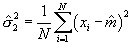
The bias property describes the relationship between the function being estimated and the mean value of the estimator. For instance, when estimating the mean value of a random variable using equation 4.33, = m and the estimator is said to be unbiased. If another estimator for mean value, , was used, perhaps the result would be ? m. This estimator is said to be biased. This is generalized for any estimator, ( x), being a function of the set of N measurements, { x i}. If E[ ( x)] = g( x), then the estimator is unbiased; otherwise, the estimator is biased. Equation 4.34 computes the samples variance and is an unbiased estimator because E[ ] = ? 2. There exists another estimator that is more intuitive because the coefficient of the summation is 1/ N. It is defined as

(4.75)

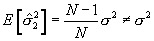
However, this estimator is biased because

(4.76)

These relationships are derived in many introductory books on probability and statistics and are left for the reader to review. Some references...

UNLIMITED FREE
ACCESS
TO THE WORLD'S BEST IDEAS

SUBMIT
Already a GlobalSpec user? Log in.

This is embarrasing...

An error occurred while processing the form. Please try again in a few minutes.

Customize Your GlobalSpec Experience

Category: Diodes
Finish!
Privacy Policy

This is embarrasing...

An error occurred while processing the form. Please try again in a few minutes.