Introduction to Applied Statistical Signal Analysis: Guide to Biomedical and Electrical Engineering Applications, Third Edition
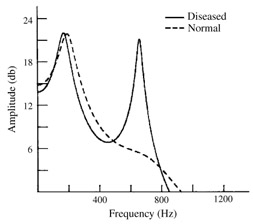
This chapter has a twofold purpose: to provide some basic principles and definitions that are essential for understanding additional approaches for analyzing random signals, and to introduce some basic concepts and applications of filtering. The important properties of some random signals reside in the frequency domain. Figure 6.1 shows the spectra of two heart sounds measured during diastole. It is obvious that the diseased heart has more energy at relatively higher frequencies than the normal heart. However, direct Fourier transformation is not sufficient for performing the frequency analysis. Other concepts must be used and are based on the definition of signal power. This leads to two nonparametric methods for frequency analysis: the periodogram and Blackman-Tukey methods, which are presented in Chapter 7. Another entirely different approach involving systems concepts is also commonly used. Because this approach requires the estimation of system parameters, it is called the parametric approach. The intermediate step is to actually create a discrete time model for the signal being analyzed. For this we must study some basic principles of discrete time systems. Comprehensive treatments of discrete time systems can be found in books, such as Cavicchi (2000), Porat (1997), and Proakis and Manolakis (1996). Parametric spectral analysis will be studied in Chapter 8.
Harmonic analysis for deterministic waveforms and signals...