Introduction to RF Stealth

Providing a new generation of designers with a firm and proven basis for new developments, this book presents and explains first order methods for the design of active and passive stealth properties.
 TABLE OF CONTENTS
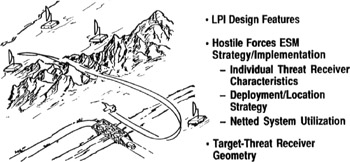
 LPI radar or data link performance is a complex function of many variables. Three main elements of LPIS performance affect a stealthy system's success.
The actual design features incorporated into the emitting system specifically for LPI.
The ESM strategy and corresponding implementation utilized by threat forces. Hostile forces' ESM strategy and implementation are very important factors affecting any LPI design. Design strategy begins with an analysis of individual threat receiver characteristics against which the LPIS may be deployed. The EOB deployment and location strategy for intercept receivers must also be considered so as to create the most successful design features. Additionally, the issue of whether or not individual interceptors are netted has a strong influence on the strategies an LPIS might use.
The geometry between the area of regard (AOR) and threat receivers.
These design and performance considerations are summarized in Fig. 2.1. LPI design constraint features, some netting constraints, and target or emitter to threat receiver geometry are covered in this chapter. Chapter 3 covers individual threat receiver characteristics. Chapter 4 covers deployment and location strategies.
There are seven main interceptability parameters or constraints.
LPI system mainlobe power at the intercept receiver
LPI system sidelobe power level at the intercept receiver
Area of mainlobe and sidelobes on the ground or at a certain threat altitude
Time of AOR illumination for mapping, tracking, or targeting
Intercept receiver density and search timeM
Intercept receiver detection response