Introduction to RF Stealth

Providing a new generation of designers with a firm and proven basis for new developments, this book presents and explains first order methods for the design of active and passive stealth properties.
 TABLE OF CONTENTS
 In the preceding section, a radiation field arising from an aperture distribution of time-varying currents was described. Now, some small-scale idealized current distributions and their associated electromagnetic fields will be discussed. These elements are useful models in real low-sidelobe and low-RCS antennas.
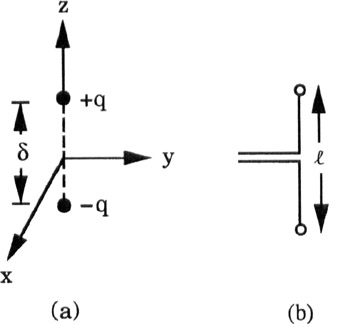
The simplest form of idealized radiator is the electric dipole shown in Fig. 6.5. A dipole consists mathematically of a pair of equal and opposite charges, each of magnitude q, separated by an infinitesimal distance ?. If a vector  is directed from - q to + q, then the dipole moment is a vector defined as

where
I 0 = maximum rate of change of charge, q
l = length of the dipole
The closest real-life example of such an antenna is the AM radio antenna embedded in the windshield in some cars. An antenna equivalent to a dipole also is shown in Fig. 6.5. It consists of thin wires terminated in small spheres, and the assumed dimensions are very small as compared with a wavelength. The spheres form the capacitive element of the structure, and the charge at any instant can be considered localized to them. If the antenna is energized by RF applied across the gap at the center, the charges on the spheres are given by the magnitude of the dipole moment q 0