Introduction to RF Stealth

Providing a new generation of designers with a firm and proven basis for new developments, this book presents and explains first order methods for the design of active and passive stealth properties.
 TABLE OF CONTENTS
 The material in this section is closely modeled on books by M. Skolnik and S. Silver and is included because it is so useful in what follows. The gain function, G( ?, ?), is defined as the ratio of the power, P( ?, ?), radiated in a direction, ( ?, ?), per unit solid angle to the average power radiated per unit solid angle. The average power radiated per unit solid angle is equal to the total power, P t, divided by 4 ?. Thus,

The radiated directive gain can be written as

The maximum power per unit solid angle is the peak of the radiation pattern, P( ?, ?), and the total power radiated is the integral of the volume under the radiation pattern. Equation (6.2) can be written as

where ? is defined as the "cookie cutter" beam area described in Chapter 2.

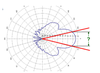
The beam area is the solid angle through which all the radiated power would pass if the power per unit solid angle were equal to P( ?, ?) P max over the disk (as shown in Figs. 2.13 and Figs. 2.14) that defines an equivalent zero sidelobe antenna pattern. If ? az and ? el are defined as the half-power beamwidths in two orthogonal surfaces, the beam area, ?, is...