The Linear and Digital Integrated Circuits Design Primer

An instrumentation amplifier is used to measure and control physical quantities such as temperature, humidity, light intensity, and waterflow.
The features needed for an instrumentation amplifier are
high gain accuracy,
high CMRR,
high gain stability with very low temperature variation,
low DC offset voltage, and
low output impedance.
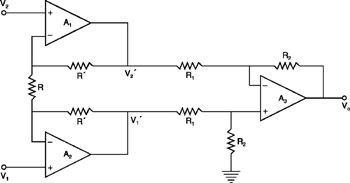
A basic instrumentation amplifier is a simple difference amplifier. In practice, a three-stage difference amplifier is used as an instrumentation amplifier, as shown in Figure 4.8.
For this circuit, the output V o can be derived as
| (4.29) | |
By varying resistance R, the gain can be varied.
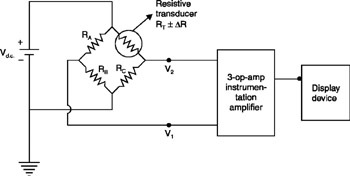
The practical circuit to measure the variation in a physical quantity is shown in Figure 4.9.
Initially, the bridge is balanced to get the output to be zero. As the physical quantity varies, the resistance in one arm is varied, therefore V 1 ? V 2 and as a consequence, the output shown in the display device is not equal to zero.