Machinery Vibration: Alignment

This section will define some geometry that is relevant to alignment. Each term will be defined and its engineering symbol shown in accordance with American National Standard ANSI Y 14.5 - 1973, "Dimensioning and Tolerancing for Engineering Drawings." After each definition, there will be a short discussion of its applicability to alignment.
Angularity: The condition where one plane or line is oriented at an angle from another plane or line. ![]()
Two shaft centerlines always form a compound angle to each other. These are projected as simple angles onto the vertical and horizontal planes.
Axial: In the direction of the shaft centerlines or, alternately, in the long direction of a cylindrical machine housing along its centerline.
Circular Runout: The composite control of circular elements of a surface as the part is rotated through 360 . ![]()
This is measured with a dial indicator on the surface of a shaft as it is rotated. It is a combination of nonroundness, bend in the shaft, and bearings not maintaining a constant rotating center.
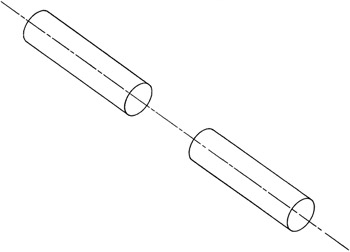
Coaxial: This exists when two or more features have a common axis.
Achieving closer coaxiality is the purpose of shaft alignment efforts, Fig. 3.3.
Figure 3.3: Coaxial shafts.
Concentric: A condition in which two or more features (cylinders, spheres, cones, hexagons, etc.) have a common axis. ![]()
The bore of couplings should be concentric with the outside diameter. A dial rotated around the stationary coupling half in Fig. 3.4( a) will measure no deviation (if...