Machinery Vibration: Alignment

Computers

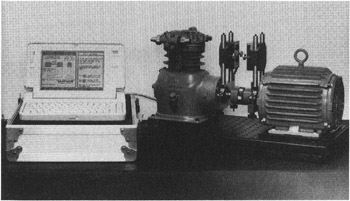
Digital computers have been adopted into the alignment process to perform two tasks to acquire the data and to perform the move calculations. To acquire the data, the sensors must be cabled directly to the box that houses the computer. This means that the sensors are either laser or electronic, which produces a voltage proportional to some deviation. The computer queries a voltmeter or data acquisition circuit with an analog-to-digital converter, for the values at some stopping points selected by the operator. When a complete set of values has been acquired, the computer can proceed to calculate the movement required at the feet. This automates the alignment process and removes some opportunity for confusion. However, the operator must follow a prescribed sequence of data entry and button pushing. There is little room for variation, because the computer is expecting values in a certain sequence to be entered into storage bins. Figure 3.53 shows a computerized alignment system.


Figure 3.53: Computerized alignment system. ( Courtesy of Dynamics Research Corp.)

These computerized data acquisition systems have cables that will get wrapped around the shaft. This is a mild nuisance, and it also encourages the operator to swing only 360 , then return in a reverse rotation to acquire the next set of data. This is poor alignment procedure and poor metrology practice. It is always best to continue rotation in the same direction, preferably the machine's normal direction of rotation. This way, the coupling articulates in its normal mode. Good metrology practice...

UNLIMITED FREE
ACCESS
TO THE WORLD'S BEST IDEAS

SUBMIT
Already a GlobalSpec user? Log in.

This is embarrasing...

An error occurred while processing the form. Please try again in a few minutes.

Customize Your GlobalSpec Experience

Category: Computers
Finish!
Privacy Policy

This is embarrasing...

An error occurred while processing the form. Please try again in a few minutes.