Machinery Vibration: Alignment

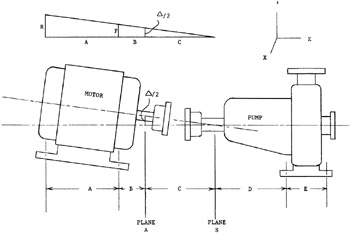
Dial-indicator measurements at the shafts do not tell the mechanic how much to move the machine. The corrections must be done at the machine feet, specifically the locations that bolt the machine down. It would be useful if measurements for misalignment could also be made there. The present state of the technology is that measurements and corrections are done at different places. This means that the dial-indicator readings at the shafts must be projected to the feet locations. This projection is done with proportional triangles.
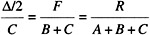
The method of proportional triangles is to simply extend the dial indicator's deviations out to a further distance, i.e., to the feet. This is shown in Fig. 3.38. The motor is the movable machine. The dial-indicator deflections are measured in planes A and S. The move numbers are desired in planes of the motor feet. The small triangle between A and S has a dial-indicator deflection ?, which is twice the offset in that plane. The motor has to be lowered an amount F at the front foot and R at the rear foot. All of the triangles are proportional, and the required moves at the feet are calculated as:
Similarly, horizontal moves are calculated as a ratio: 1/2 of the total indicator reading side-to-side divided by the distance C. The front foot and rear foot moves are proportional to their axial distances. This is the principle. The formulas for face-and-rim and reverse-indicator...