Machinery Vibration: Alignment

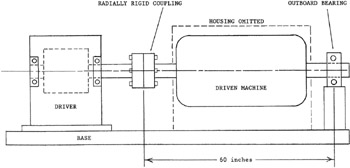
"Single-bearing machine" is a misnomer. There is no such thing. Any machine component with a length other than zero must have two points of support, or else it will hang like a pendulum from its single support point. What really is meant with the term "single-bearing machine" is two machines coupled together with three hard bearings. The coupling between the two machines functions as the fourth bearing. It serves a dual function as a coupling and a bearing. Therefore, the coupling must be radially rigid to support a load. Figure 14.1 shows such a configuration, which is common for diesel engine-driven generators. Bolting the generator stator housing to the engine flywheel housing eliminates the need for the base to absorb the engine's driving torque. The base can be lighter.
Other reasons for designing such a machine configuration is to remove unnecessary constraints, decrease parts counts, shorten the machine assembly longitudinally for a more compact design, and in some cases, remove one thrust bearing. A two-machine, four-bearing system with a radially rigid coupling is actually a five-bearing system. All five bearings must be in line to avoid dynamically bending the shafts. That means that the shafts must be straight and well aligned. If the coupling is radially flexible, then it will suffer fatigue damage or abrasive wear if the two shafts are misaligned. A good engineering design principle is to not over...