Machinery Vibration: Alignment

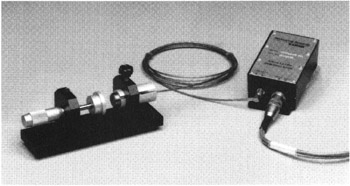
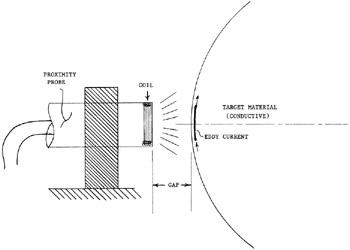
The proximity probe is an electronic substitute for the dial indicator with one important distinction it is noncontact. A proximity probe is shown in Fig. 3.46. These probes come with an oscillator/demodulator and a length of cable. This transducer system must be calibrated as a unit for each specific material. Calibration constants are from 1 millivolt/mil to 1,000 millivolts/mil. Larger-diameter probes have a larger range, up to 2.0 inches. Proximity probes operate on the eddy current principle. The target surface must support an eddy current, that is, be conductive, Fig. 3.47.
The oscillator generates a high-frequency signal to the coil in the probe tip. The coil functions as an antenna and radiates a signal that is mostly directed toward the target. The target reacts with eddy currents with varying current depending on the gap distance to the target. This eddy current radiates a signal of its own that couples to and modifies the original signal. The demodulator detects this change in the original signal. The response is nonlinear, but the demodulator contains a linearizing circuit, in addition to a filter to remove the original oscillating signal, and a voltage conversion. The result is a voltage signal at the oscillator/demodulator, which is proportional to the gap distance, typically 200 mv/mil.
The proximity probe, like the dial indicator, is a relative displacement sensor. It cannot tell if the...