Machinery Vibration: Alignment

Chapter 12: Large, Heavy, or Multiple Machines

Overview

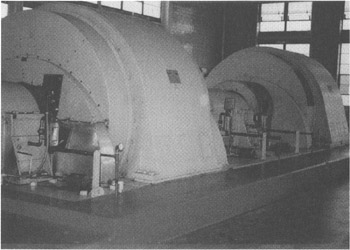
The principles for aligning large and heavy machines that enclose the bearings in a single cast-iron housing are similar to what has been covered in previous chapters, with additional emphasis on the structure and on planning. Large machines are more rigid and the housings distort less with bolt tensioning. Consequently, they respond more linearly and move into the desired positions with less twisting or other distortions. Remember that all alignment move calculations are linear calculations, and when the world responds in a linear manner, our mathematical model is more valid. The static loading does cause bending and distortion in the shaft, housing, bearing supports, and foundation. Large machines have large foundations to support large dead weights. A structural analysis is required for heavy machines to assess the amount of compression in the foundation in addition to the amount of shaft sag. It is desirable to align a large, heavy machine along its natural sag curvature to minimize bending stresses in the shaft and to minimize reversed stresses in the coupling. Initial positioning of the bearings is done with a "bore" alignment, but final adjustments are done with the rotors and housings in place and the structure fully loaded. Figure 12.1 is an example.


Figure 12.1: Two 23,500-hp AC induction motors in tandem.

Additional planning is the major chore of aligning large, heavy, or multiple machines. Because of the logistics required in lifting and moving something large and heavy, we want to do this only once or twice. The measurements...

UNLIMITED FREE
ACCESS
TO THE WORLD'S BEST IDEAS

SUBMIT
Already a GlobalSpec user? Log in.

This is embarrasing...

An error occurred while processing the form. Please try again in a few minutes.

Customize Your GlobalSpec Experience

Category: Flange Mounted Bearings
Finish!
Privacy Policy

This is embarrasing...

An error occurred while processing the form. Please try again in a few minutes.