Manual of Applied Field Hydrogeology

Providing plenty of practical examples, this hands-on guide offers actual procedures and real-world decisions that will help you to stay leagues ahead in field hydrogeology.
 TABLE OF CONTENTS
 Groundwater is generally always moving. Movement occurs from higher hydraulic head in recharge areas (natural or artificial), where precipitation is generally higher, to discharge areas of lower hydraulic head (wells, springs, rivers, lakes, and wetlands). The reason groundwater moves is because there always seems to be a "change in head" or some kind of hydraulic gradient or slope in potentiometric surface of a groundwater system. Gravity is the driving force that moves water. Infiltrating groundwater moves downward until it reaches a horizon with low enough hydraulic conductivity to begin piling up. Groundwater moves so slowly (feet/year to feet/day) that "piles" of water in recharge areas may build up or mound before their effects in the system can be equilibrated. If you picked up one corner of a bathtub full of water, gravity would cause the water to move towards the low corner. If the bathtub were filled with saturated sand and you picked up a corner (you would be very strong!), water would still move, but much more slowly. The quantity of groundwater movement through porous media is defined through Darcy's Law (Figure 5.1).
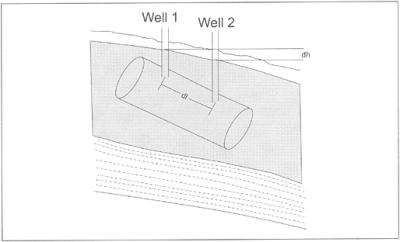
In the mid-nineteenth century, Henry Darcy (1856) systematically studied the movement of water through sand columns. He was able to show that the volumetric rate (Q) of groundwater was proportional to the intrinsic permeability (see Chapter 3) of the porous media (k) and the change in head (hydraulic gradient))...