Manual of Applied Field Hydrogeology
Providing plenty of practical examples, this hands-on guide offers actual procedures and real-world decisions that will help you to stay leagues ahead in field hydrogeology.
 TABLE OF CONTENTS
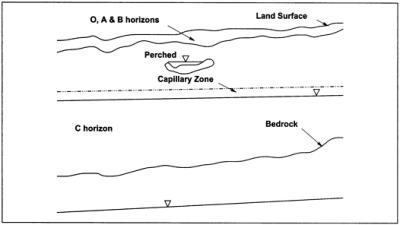
 The vadose zone is composed of the materials from the land surface down to the water table, including the capillary fringe or zone (Figure 12.1). Typically, this includes a significant soil zone, partially disintegrated bedrock, and bedrock, where the land surface is not underlain by alluvial or glacial deposits. Generally, the soil zone consists of the finest particles, constitutes the limiting factor for recharge, and contains much of the stored soil water used by plants; hence, this zone has received the majority of the attention in past studies (not to mention that it is the most accessible horizon and the easiest to install instruments into). Understanding the dis- tinction between the vadose and saturated zones, and the strengths and weaknesses of vadose-zone monitoring and vadose-zone flux calculations or estimates are your goals for this chapter.
Water budgets (Chapter 1) generally have fairly large (percentage-wise) error estimates for evapotranspiration and recharge. Rainfall reaching the land surface initially wets the surficial soil layer. Soil scientists will refer to the depth to which a "wetting front" has advanced (from the surface downward) when water reaches the land surface. Ponding of water on the land surface may be natural (simply the accumulation of runoff in topographic lows) or result from an artificial structure to...