Manual of Applied Field Hydrogeology
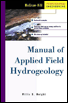
Providing plenty of practical examples, this hands-on guide offers actual procedures and real-world decisions that will help you to stay leagues ahead in field hydrogeology.
 TABLE OF CONTENTS
 Marek Zaluski, Ph.D.
A tracer test is a field method used in hydrogeology to quantify selected hydraulic or hydrochemical parameters. In its most common form, a tracer test is conducted by emplacing a defined quantity of traceable substance or a heat source within the aquifer and tracking it down hydraulic-gradient, where at certain points of space and time, its quantity is measured. This form of a tracer test can be viewed as a positive-displacement slug test or an injection test in which stress to the aquifer is delivered in the form of chemical substance or a heat source, rather than by injecting a known volume of water. Dissipation of such a stress with respect to time and the aquifer space provides a data set from which many hydrogeologic conditions may be concluded. Quantification of the groundwater flow direction and rate, aquifer porosity, anisotropy, dispersivity, retardation factor, and other physicochemical characteristics are the most common results of the tracer-test interpretation.
Other types of tracer tests deal with quantifying the dissipation of elements that naturally occur in groundwater and/or injection of certain substances that react with hydrocarbon contaminants, allowing determination of the contaminant concentration. These two types of tracer tests, as well as a large family of surface-water tracer tests (Chapter 6), are not discussed in this chapter.
Tracer tests, their objectives, theory, performance, and interpretation have been addressed in relatively broad literature. Information provided in this chapter is based on these sources as well as actual field experience of the...