Manual of Applied Field Hydrogeology
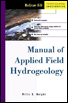
Providing plenty of practical examples, this hands-on guide offers actual procedures and real-world decisions that will help you to stay leagues ahead in field hydrogeology.
 TABLE OF CONTENTS
 Many projects will require that groundwater samples be collected and analyzed as an integral part of the project. This chapter concentrates on how to collect samples correctly, get all of the necessary field measurements, determine and order the appropriate analyses from the lab, check the laboratory results, and utilize the laboratory and field data. It is intended as an initial guideline document with questions and a checklist for you to use as an aid. However, to get the right laboratory results, you really have to know the purpose of the sampling and what regulatory constraints your client or employer will have.
At the conclusion of this chapter, you should be able to go to a source (well, spring, lake, or creek) and, after asking a few questions about the setting and the purpose of sampling, determine what methods to use and what constituents should be analyzed.
It may be useful to start by looking at what can be done with the data, provided that the sampling and analyses were done properly.
Cementing materials in granular porous media may be growing (precipitating) or dissolving, altering the effective porosity, and affecting the water chemistry. The common precipitated cementing agents are silica (SiO 2) and calcium carbonate (CaCO 3). Also, in carbonate aquifers, secondary porosity is often the main control on the permeability of the aquifer; the water chemistry can be used to evaluate dissolution and precipitation along the flow path and so...