Manual of Applied Field Hydrogeology
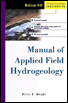
Providing plenty of practical examples, this hands-on guide offers actual procedures and real-world decisions that will help you to stay leagues ahead in field hydrogeology.
 TABLE OF CONTENTS
 Curtis A.Link
This chapter provides a basic introduction to the principles and applications of geophysical techniques as they might be applied to problems related to hydrogeology. The goal of geophysics is to determine the properties and parameters of subsurface materials (usually rock or sometimes soils) from measurements made at the surface of the earth. Even though the scale of the problem may change, the physics of the basic techniques remains the same.
Many of the techniques and methods presented can be applied at various scales such as those encountered in oil exploration, in understanding shallow lithological parameters, or in determining properties at the mantle or core level.
Since this chapter covers a variety of techniques, it is impossible to explore each method in detail. Our goal is to provide readers with a basic understanding of the various geophysical techniques that are most commonly used such that they can determine which techniques are most applicable to particular problems.
The format of the chapter will be to introduce each technique; discuss data acquisition, processing, and interpretation principles; and provide one or more application examples from the literature.
This chapter is meant to provide basic information on the most common geophysical techniques. However, for those unfamiliar with the methods and techniques of geophysics, it might be useful at this point to list some of the applications suitable for shallow geophysical techniques (list from Greenhouse et al. 1998). Please note that specific methods are site-dependent and...