Manual of Applied Field Hydrogeology
Providing plenty of practical examples, this hands-on guide offers actual procedures and real-world decisions that will help you to stay leagues ahead in field hydrogeology.
 TABLE OF CONTENTS
 In the above discussion, no information is required at your peril. Always think safety. There are few pieces of equipment with more moving parts than a drill rig. If you are within the mast length of the drill rig, then you need to be checking and looking around. You need to look up as often as you check your rearview mirror while driving a vehicle (every few seconds) because a hardhat cannot save you from a falling drill pipe. Equipment can break loose, cables can break, and conditions can change in a heartbeat. Always have a sense of caution and safety in mind.
The minimum appropriate attire at the drill site is steel-toed shoes, a hardhat, gloves, and safety glasses (Figure 8.3). If you are working at a hazardous waste site, other protective clothing will be required. Loose clothing is susceptible to becoming snagged by a rotating machine, pulling you in or getting torn up.
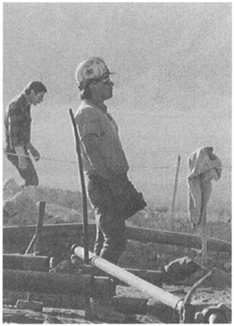
The safest place to stand near a drill rig is on the driller side (Figure 8.4). The driller is in charge of the controls and is the most knowledgeable person about what is going on. He or she is the person you need to have an ongoing dialog with and will be most helpful in answering your questions. The "helper" side is generally the direction where more things fall and more moving items are...