Mass Finishing Handbook

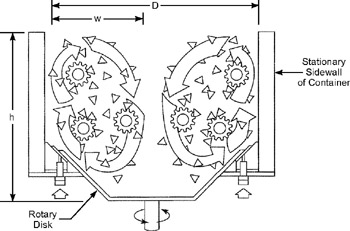
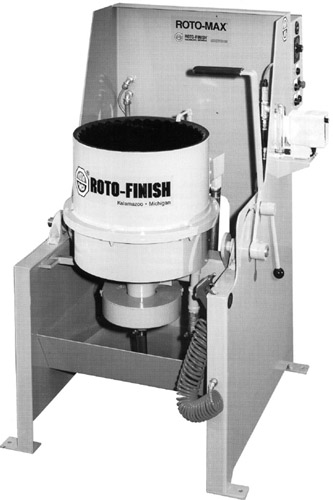
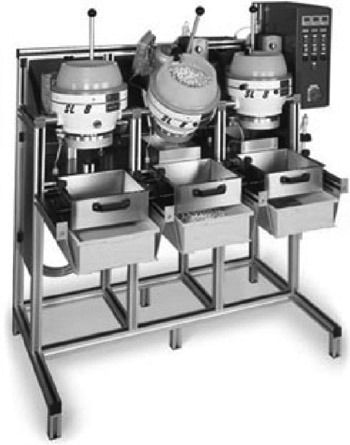
The centrifugal disk finishing process is the newest of the high-energy mass finishing methods. The centrifugal disk machine, also called the roll flow finishing machine, was reportedly invented by Yoshita in Japan and developed commercially by Roto-Finish in Germany (Choi 1998). It was introduced in England in 1969 (Coffield 1981). Machines consist of an open-top bowl having stationary sidewalls and a rotary disk for a base (see Figs. 11-1 through 11-3). Media, compound, and workpieces are contained in the bowl.
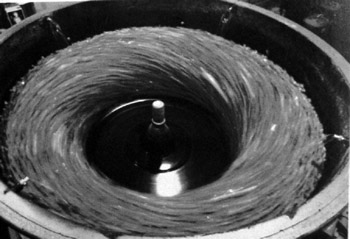
As the bottom disk rotates with peripheral speeds up to 2000 sfpm (610 m/min), the mass within the container is accelerated outward. When the media and workpieces contact the stationary sidewalls of the container the sidewalls act as a brake and the load starts to decelerate as it is forced upward by the mass behind it. The media and workpieces rise to the top of the load, flow toward the center of the container, and then downward toward the disk. This action provides a relatively smooth flow of parts and reduces the impingement found in vibratory machines. Figure 11-4 shows media action in one of these machines. Table 11-1 shows the many machine variables that are possible.