Mass Finishing Handbook

Fluidized bed finishing, also called turbo-abrasive finishing, was developed at the Soviet Research Institute for Abrasives and Grinding (VNIIASh) (Kremen & Massarsky 1977). In this process the part being finished is quickly rotated in a fluidized bed of abrasive grains. Blowing compressed air through a layer of abrasive produces the bed. Unlike blasting operations this operation uses much smaller media and the velocity of contact is less than 1 m/sec (3.28 ft/sec) (Jaganathan & Radhakraisnan 1997). The process is characterized by low viscosity and high fluidity.
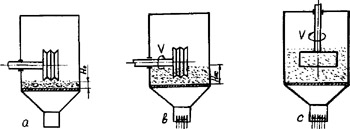
Figure 16-1a shows the horizontal part in the chamber before the abrasive is made fluid. Figure 16-1b shows the media rising in the chamber as a result of the air supply. This is the fluidized bed of abrasive. Figure 16-1c shows the same part inserted vertically through the top of the machine (Kremen 1998).
Alone the abrasive action of the fluidized bed is weak only about 0.03 ?m (1.2 ?in.) are removed in a minute. When the part is given a fast motion preferably a rotational one the rate of removal increases by a factor of 30 to 60. In one experiment the upward velocity of the media is only 0.75 m/sec (2.46 ft/sec) while the spindle speed produces velocities at the part edges of 2.5 to 3 m/sec (8.2 9.84 ft/sec). Other applications involve surface velocities of up to 30 m/sec (98.4 ft/sec). The upward flowing abrasive stream forms a temporary feath-erlike...