Mass Finishing Handbook

Immersion lapping, according to German standard DIN 8589, Part 17 (draft), is "a form of slip abrasion by immersion or slip lapping. This is produced by a relative movement between the workpiece and the grinding medium by virtue of a plain rotation movement." It employs higher speeds and smaller grinding chip sizes than flow finishing [1], which uses typically 6 12 m/sec (20 40 ft/sec) part rotation speed and chip movement speeds of 15 18 m/sec (49 59 ft/sec). In Germany, immersion lapping ( Tauchl$aUppanlage) usually uses a ring of lapping medium formed against the wall of a rotating drum by centrifugal force and a rotating work-piece moved into the ring. The lapping medium is a pasty polyurethane-based abrasive containing additions of corncobs or nutshell granules, sawdust, and clay. This mixture can be fluidized with compressed air (Przyklenk & Schlatter 1987).
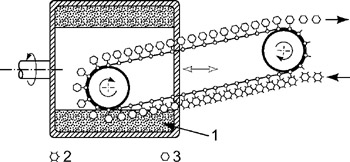
The process definition above also defines the elements of spindle finishing. For the purposes of this book, immersion lapping refers to the continuous process shown in Fig. 15-1. As seen there, fixtured parts are fed into a horizontal axis barrel, which revolves fast enough to throw the media to the outer walls. The parts pass through this moving ring of material and out on a continual basis. The parts may or may not be rotated as well.
As shown in Fig. 15-1, the media is contained in a horizontal barrel that is rotated fast enough...