Mass Finishing Handbook

In the recipro-finishing process workpieces are moved back and forth in a stationary tub containing media. The workpieces must be attached to a holding device (Fig. 17-1). The process permits handling large or odd-shaped parts. Finishing action may be concentrated on certain areas while other areas are shielded. Processing cycles are normally 5 15 minutes and surface roughness changes from 120 ?in. 44 ?in. (3 ?m 1.1 ?m). Finer finishes may also be produced.
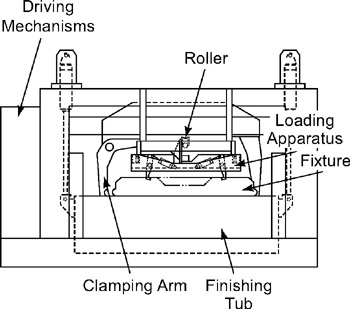
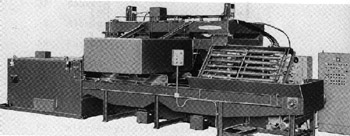
Recipro-finishing can be fully automated. One automated design incorporates a traverse unit that reciprocates on rails fixed to an upper frame, with fixture-clamping arms pivoted to the traverse unit, a loading apparatus, and a transfer mechanism for loading and unloading (Fig. 17-2). Several modifications of these machines are in use including one type that employs spindle rotation for automotive wheels. These wheels are finished in 2 minutes with a spindle rotation of 120 rpm and 10 cycles per minute reciprocation. Wavy motion machines have also been built (Kobayashi and Matsunaga 1977).
One machine provides a wavy motion rather than the typical linear movement, and another reciprocates vertically while the spindle turns (Anonymous 1970).
Recipro-finishing also has been identified with the names Recipro-skating (Japan) and Metaphor (U.S.) (Anonymous 1970).
Although this process could conceivably produce finishes as fine as 0.05 ?m, in a deburring cycle, finishes of...