McGraw-Hill Machining and Metalworking Handbook, Third Edition
This chapter covers all the basic and special mathematical procedures of value to the modern machinist and metalworker. Geometry and plane trigonometry are of prime importance, as are the basic algebraic manipulations. Solutions to many basic and complex machining and metalworking operations would be difficult or impossible without the use of these branches of mathematics. In this chapter and other subsections of this Handbook, all the basic and important aspects of these branches of mathematics will be covered in detail.
lf A/ B = C/ D, then
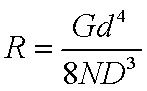
Transposing an equation. We may solve for any one unknown if all other variables are known. The given equation is
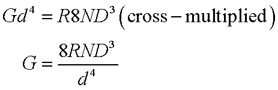
an equation with five variables, shown in terms of R. Solving for G gives
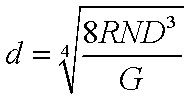
Solving for d gives
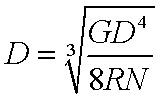
Solving for D gives
Solve for N using the same transposition procedures just shown.
Solving a typical algebraic equation. An algebraic equation can be solved by substituting the numerical values assigned to the variables, which are denoted by letters, and then finding the unknown value.
Example:
If C = 16, D = 5.56, and d = 3.12 (the variables), solve for L (by substituting the values of the variables into the equation):
Most of the equations shown in this Handbook are solved in a similar manner, i.e., by substituting known values for the variables in the equations...