McGraw-Hill Machining and Metalworking Handbook, Third Edition
Modern engineering drawing practices have been greatly influenced by the widespread acceptance of computer-aided design (CAD) packages. Although these systems have greatly simplified the process of documenting dimensions, tolerances, and other important information, having a basic understanding of drawing practices is still essential. This chapter also covers procedures for determining limits and fits on hole/shaft systems because this is an important activity related to dimensioning and tolerancing.
Our definition of tolerance is the amount of dimensional variation allowed on a part or assembly of parts. Tolerance is equal to the difference between maximum and minimum limits of the specified dimension. For example:
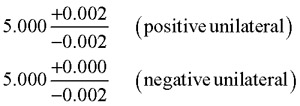
Unilateral and bilateral tolerances. Unilateral tolerance is used to relate the total tolerance to a basic dimension in one direction only. For example:
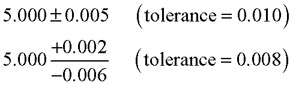
Bilateral tolerance is used to relate the total tolerance to a basic dimension in both plus and minus directions. For example:
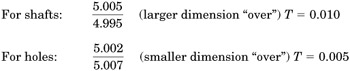
Showing dimensional tolerances in an over-and-under form is as illustrated:
Tolerancing practices. Tolerances are applied to show the permissible variation in the direction that is the least critical. If variation in either direction is equally critical, the bilateral tolerance is used. If a variation in one direction is more critical than a variation in another direction, the unilateral tolerance should be given in the least critical direction.
For example, if you want the diameter of a round rod not to exceed 3.000 in but will allow it to go under to 2.995 in, this is...