Mechanical Design of Microresonators: Modeling and Applications

Chapter 2: Basic Members Lumped- and Distributed-Parameter Modeling and Design

2.1 Introduction

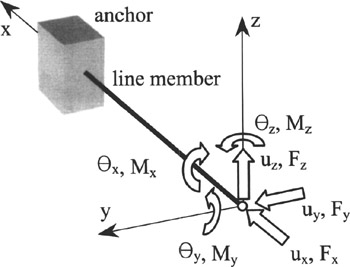
In this chapter we study the methods of determining the resonant frequencies of basic micromembers such as one-dimensional or two-dimensional ones by using the lumped-parameter modeling and the distributed-parameter technique. Microhinges, microcantilevers, and microbridges, in their most common configurations, can be modeled as line elements of either constant or variable cross section. More specifically, microhinges and microcantilevers can be characterized in terms of their resonant behavior by means of lumped-parameter elastic and inertia properties defined about 6 degrees of freedom that are associated to the free endpoint, namely, three translations ( u x, u y, and u z) and three rotations ( ? x, ? y, and ? z), as suggested in Fig. 2.1. These degrees of freedom are physical deformations (either linear or rotary) of the member itself and are produced by actuation or interaction with supports and/or adjacent members through bending, torsion, and/or axial loading. As shown in the following, these degrees of freedom are related to the corresponding loads (the forces F x, F y, F z and the moments M x, M y, M z) in the static domain by means of stiffnesses or by means of compliances.


Figure 2.1: Fixed-free line member with 6 degrees of freedom as a schematic representation for microhinges and microcantilevers.

The stiffness and mass can be lumped at the free end of a fixed-free (microcantilever) member, such as the one in Fig. 2.1. The lumped stiffness

UNLIMITED FREE
ACCESS
TO THE WORLD'S BEST IDEAS

SUBMIT
Already a GlobalSpec user? Log in.

This is embarrasing...

An error occurred while processing the form. Please try again in a few minutes.

Customize Your GlobalSpec Experience

Category: Multi-axis Positioning Systems
Finish!
Privacy Policy

This is embarrasing...

An error occurred while processing the form. Please try again in a few minutes.