Mechanical Design of Microresonators: Modeling and Applications

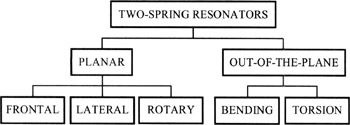
Micro- and nanoresonators can be built with several complex elastic suspensions, including those based on beam-type springs, as previously discussed. The simplest multispring microresonators utilize two springs to achieve the resonant motion, as indicated in Fig. 5.31.
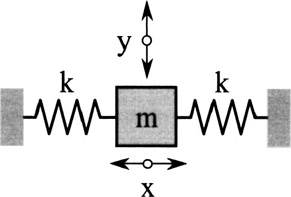
The planar designs are capable of motion in a plane parallel to the substrate, and Fig. 5.32 shows the sketches of frontal and lateral motion solutions. The x direction vibration corresponds to the frontal solution whereas the y direction solution is the lateral motion design.
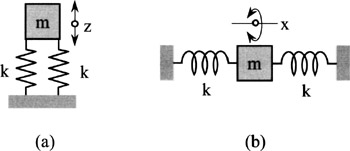
In out-of-the-plane microresonators, the motion is no longer parallel to the substrate and can be produced by either bending or torsion; the corresponding lumped-parameter models are sketched in Fig. 5.33a and b.
Several spring designs that are currently utilized in microresonators and enable parallel motion of a resonant device above the substrate are presented next. Figures. 5.34 through 5.38 are illustrations of spring pairs which realize both the suspension of the microresonator and the elasticity (compliance) function. More details regarding stiffness calculations for those springs are provided by Lobontiu and Garcia, [7] for instance. Figure 5.34 shows a proof mass which is symmetrically supported by two U springs. The actuation and sensing are performed electrostatically by means of comb-type units. This microsystem is designed to produce unidirectional frontal motion of the proof mass about the x direction.
Another...