Mechanical Design of Microresonators: Modeling and Applications

5.5: Resonant Microgyroscopes

5.5 Resonant Microgyroscopes

Gyroscopes in the macroworld are bodies with a fixed position which can freely rotate about three independent axes under the action of external forces and moments. In the micro- and nanodomain, gyroscopes are mostly utilized as sensors of an externally applied angular velocity. Applications of microgyroscopes include automobile control, inertial navigation, platform stabilization, motion compensation in video cameras, inertial mouse devices in computers, virtual reality devices, robotics, and surgical instruments, as indicated by Fujita, Maenaka, and Maeda; [14] Li et al.; [15] Yang et al.; [16] Kawai et al.; [17] Geiger et al.; [18] Degani et al.; [4] Nakano, Toriyama, and Sugiyama; [19] Ajazi and Najafi; [20] Yazdi, Ayazi, and Najafi; [21] or Park et al.; [22] to cite just a few of the works dedicated to microgyroscopes.

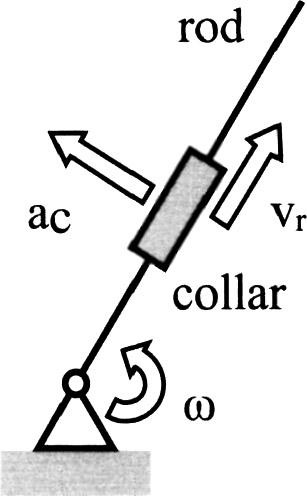
The operating principle of gyroscopes is based on the Coriolis effect which is illustrated in Fig. 5.46.


Figure 5.46: Collar sliding on a rotating rod as an example of the Coriolis effect.

The collar slides on the rod with a relative velocity v r while the rod undergoes a rotary motion with an angular speed ?. It is known from dynamics that an additional acceleration is produced, which is named the Coriolis acceleration; its vector definition is


and is directed as shown in Fig. 5.46. A better representation of the Coriolis acceleration is seen in Fig. 5.47a where the relative velocity and Coriolis acceleration are coplanar while...

UNLIMITED FREE
ACCESS
TO THE WORLD'S BEST IDEAS

SUBMIT
Already a GlobalSpec user? Log in.

This is embarrasing...

An error occurred while processing the form. Please try again in a few minutes.

Customize Your GlobalSpec Experience

Category: Motion Reference Units (MRU)
Finish!
Privacy Policy

This is embarrasing...

An error occurred while processing the form. Please try again in a few minutes.