Mechanical Design of Microresonators: Modeling and Applications

Several mechanical microresonators are studied in this section comprising flexible, beam-type members, which can deform by either bending or torsion. Three models are developed which are based on various levels of approximation with respect to stiffness and inertia properties and which yield the main resonant frequencies. The simplest resonant systems are single-degree-of-freedom, but multiple-degree-of-freedom (multiple-DOF) systems are also discussed. This study analyzes paddle microcantilevers, paddle microbridges, as well as other beam microresonators.
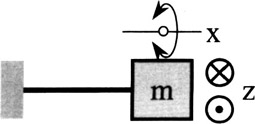
Paddle microcantilevers are discussed in Chap. 3 where their relevant lumped-parameter stiffness and inertia fractions are derived by considering contributions from both segments of the composite structure. A paddle microcantilever is sketched in Fig. 5.1, which highlights the main degrees of freedom (bending, represented by the z translation, and torsion, symbolized by the x axis rotation).
In some cases the end segment is massive and considerably stiffer than the root (anchor) one; these features warrant utilizing a simplified lumped-parameter model where stiffness only comes from the root segment whereas inertia is only produced by the free-end portion. An intermediate modeling case is also possible, resulting from the previous model, where inertia is contributed to by both segments. The third modeling possibility takes into consideration stiffness and inertia contributions from both segments and is thoroughly analyzed in Chap. 3. The three models are shown and characterized in Fig. 5.2.
While the stiffnesses yielded by models I and II are...