Mechanical Design of Microresonators: Modeling and Applications

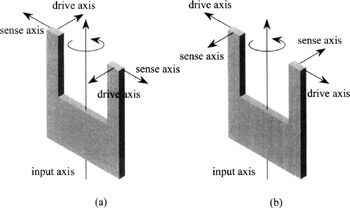
Tuning forks have long been used as standard pitch tools for musical instrument calibration. Another utilization of tuning forks is in the clock and wristwatch industry as frequency standards. Resonating tuning forks, such as the ones introduced in Chap. 1, can also be employed as microsensors in a similar manner to gyroscopes in detecting changes in an external angular velocity, as shown by Satoh, Ohnishi, and Tomikawa; [23] Sato, Ono, and Tomikawa; [24] Momosaki; [25] or Matsiev. [26] The tuning forks operate similarly to gyroscopes, and the Coriolis effects are again the underlying principle. The classical tuning fork sensor is sketched in Fig. 5.53, where two variants are outlined. In the first variant, the driving is out-of-the-plane, which results in Coriolis accelerations pulling away the two tines in their plane (Fig. 5.53a). In the second variant (Fig. 5.53b), driving and sensing interchange, with the net result that the two tines are deformed out-of-the-plane through Coriolis effects.
The vibrational amounts involved in one tine of the tuning fork are sketched in Fig. 5.54. The input to the tine consists of the angular velocity ? which is applied about the z axis. A sinusoidal force is driving the tine about the x axis, and the result is a relative velocity v r of the tip of the tine about the same axis. The interaction between the...