Mechanical Design of Microresonators: Modeling and Applications

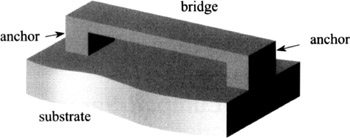
This chapter will analyze microbridges, which are fixed-fixed members, as shown in Fig. 4.1. Constructively, a microbridge might be identical to a microcantilever (or a microhinge), except for the end boundary conditions, although specific designs can be utilized for either category.
Bridges are mainly implemented in micro- and nanosensing and radio-frequency (RF) applications. Fabrication advances that permit size reduction of bridge resonators in the nanometer realm substantially improve the performance of devices that are designed to capture the effects of extraneous mass attachment. Attogram (10 ?15 g) quantities deposited on chemically prepared mechanical nanooscillators can be detected through shifts in the resonant frequencies. Simple doubly clamped beams and paddle bridges have been utilized to monitor various processes of mass addition by Ilic et al. [1] Sekaric et al., [2] , [3] or Evoy et al. [4] among others. Such nanodevices perform with sensitivities in the 10 ?19 g/Hz domain and are capable of sensing deposition of substances at the cellular level. More details on mass addition detection by means of micro- and nanoresonators are given in Chap. 6.
One of the smallest NEMS oscillators reported, by Husain et al., [5] is a nanowire only 1.3 ?m long and 43 nm in diameter with a resonant frequency of more than 100 MHz. Microbridge resonators have also been researched from other angles to address topics such as electromechanical frequency tuning by Syms, [6]