Mechanics of Materials

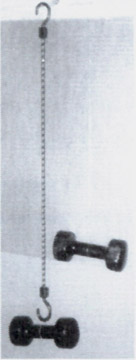
A metal wire and a rubber stretch cord that have the same undeformed lengths and are subjected to the same loads deform by significantly different amounts, as shown in Figure 3.1. That rubber deforms significantly more than metal is not a surprising result, but it emphasizes that material properties must play an important role in developing formulas relating deformation to applied forces. How do we describe the mechanical properties of materials? This chapter discusses the qualitative as well as the quantitative characterization of a material's mechanical properties.
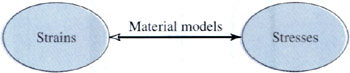
Qualitative descriptions of a material by adjectives such as elastic, ductile, or tough have very specific meanings that must be understood, for these adjectives form the engineering language of material description. Quantitative material descriptions are the equations of the curves that pass through the experimental observations of stress and strain values. A material model is a specific equation with a certain number of parameters that is chosen to describe the relationship between stresses and strains, as shown in Figure 3.2. The parameters in the equation are usually determined by fitting a curve through experimental observations in a least-squares manner. [1]
Figure 3.2 shows the last link that we need to construct the chain of logic relating deformation to forces. As mentioned in earlier chapters, we will use this logic to develop the theories for relating stresses and deformation to applied loads for axial members, shafts, and beams.
The...