Mechanics of Materials

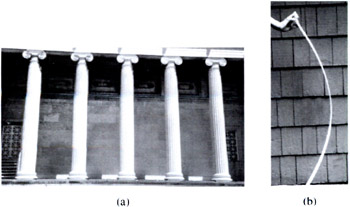
The weight of the building exerts a compressive axial force on the columns shown in Figure 11.1a. If a compressive axial force is applied to a long thin wooden strip, then it bends significantly, as shown in Figure 11.1b. If the columns were to bend the same way as the wooden strip, then the columns and the building would collapse. Under what conditions will a compressive axial force produce only axial contraction, and when does it produce bending? When is the bending caused by axial loads catastrophic? How do we design to prevent catastrophic failure from axial loads? We study answers to these questions in this chapter.
Bending due to a compressive axial load is called buckling. Structural members that support compressive axial loads are called columns. As shall be seen in this chapter, the phenomenon of buckling is the study of the stability of a structure's equilibrium. This stability problem is a critical design issue because when a structure collapses due to instability, the collapse is sudden and usually catastrophic. Fortunately it is possible to identify members in a structure that are likely to collapse. One critical requirement for instability is that the structural members be in compression.
Geometry, material, boundary conditions, and imperfections are some of the important factors that affect the stability of columns.
The two learning objectives in this chapter are:
Develop an appreciation of the phenomenon of buckling and the various types of structure instabilities.