Mechanics of Materials

Chapter Ten: Design and Failure

10.0 OVERVIEW

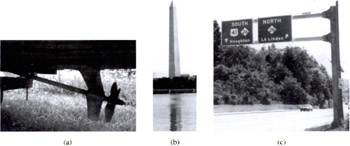
The propeller on a boat, shown in Figure 10.1a, subjects the shaft to an axial force as it pushes the water backward and a torsional load as it turns through the water. Gravity subjects the Washington Monument, shown in Figure 10.1b, to a distributed axial load and the wind pressure of a storm will subject the monument to large bending loads. Wind pressure on the highway sign shown in Figure 10.1c subjects the base to bending as well as to torsional loads. These examples are among the countless engineering applications in which structural members are subjected to combined axial, torsional, and/or bending loads simultaneously. This chapter synthesizes and applies the concepts developed in the previous nine chapters to the analysis and design of structures that are subjected to combined loading.


Figure 10.1: Examples of combined loadings.

The two major learning objectives in this chapter are:

  1. Learn the computation of stresses and strains in structural members subjected to combined axial, torsion, and bending loads.

  2. Develop the analysis skills for the computation of internal forces and moments on individual members that compromise a structure.

10.1 COMBINED LOADING

The theories for axial members in Section 4.1, for torsion of circular shafts in Section 5.2, and for symmetric bending about the z axis in Section 6.2 are all linear theories. Thus the stresses and/or strains at a point when axial, torsional, and bending loads are applied simultaneously to a structure can be obtained by the principle of superposition discussed in this...

UNLIMITED FREE
ACCESS
TO THE WORLD'S BEST IDEAS

SUBMIT
Already a GlobalSpec user? Log in.

This is embarrasing...

An error occurred while processing the form. Please try again in a few minutes.

Customize Your GlobalSpec Experience

Category: Torsion Springs
Finish!
Privacy Policy

This is embarrasing...

An error occurred while processing the form. Please try again in a few minutes.