Mechanics of Materials

Chapter Five: Torsion of Shafts

5.0 OVERVIEW

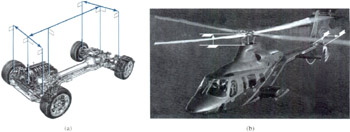
Structural members used in transmitting torque from one plane to another are called shafts. The transfer of power from the engine to the wheels in an automobile requires many shafts in the power train, some of which are shown in Figure 5.1a. The transfer of torque (power) from the engine to the rotor blades of a helicopter is shown in Figure 5.1b. Lawn mowers, blenders, circular saws, drills, and just about any power equipment in which there is circular motion will have shafts.


Figure 5.1: Transfer of torques between planes.

The simplest theory for torsion in circular shafts will be developed rigorously following the logic shown in Figure 3.15 but subject to the limitations described in Section 3.13. The formulas from the theory will be used in the design and analysis of statically determinate and indeterminate shafts.

The two major learning objectives are:

  1. Understand the theory, its limitations, and its applications for the design and analysis of torsion of circular shafts.

  2. Develop the discipline to visualize the direction of torsional shear stress and the surface on which it acts.

5.1 PRELUDE TO THEORY

Several numerical examples are solved in this section in order to develop the observations that affect the development of the theory of torsion of circular shafts.

  • Example 5.1 shows the kinematics of calculating the shear strain in torsion and the application of the logic described in Figure 3.15, using discrete bars attached to a rigid plate.

  • Examples 5.2 and 5.3 show how the kinematics...

UNLIMITED FREE
ACCESS
TO THE WORLD'S BEST IDEAS

SUBMIT
Already a GlobalSpec user? Log in.

This is embarrasing...

An error occurred while processing the form. Please try again in a few minutes.

Customize Your GlobalSpec Experience

Category: Pneumatic Brake and Clutch Assemblies
Finish!
Privacy Policy

This is embarrasing...

An error occurred while processing the form. Please try again in a few minutes.