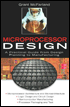
Microprocessor Design: A Practical Guide from Design Planning to Manufacturing
This chapter describes the development of the transistor, how transistors evolved into integrated circuits and microprocessors, and how scaling has driven the evolution of microprocessors.
Upon completion of this chapter, the reader will be able to:
Describe N-type and P-type semiconductors.
Understand the operation of diodes and transistors.
Understand the difference between different types of transistors.
Describe Moore's law and some of its implications.
Be aware of limits to scaling transistors and wires in integrated circuits.
Describe different schemes for scaling interconnects.
Explain the difference between "lead microprocessors" and "compactions."
List possibilities for future transistor scaling.
Processors are the brains of computers. Other components allow a computer to store or retrieve data and to input or output data, but the processor performs computations and does something useful with the data. It is the processor that determines what action will happen next within the computer and directs the overall operation. Processors in early computers were created out of many separate components, but as technology improved it became possible to integrate all of the components of a processor onto a single piece, or chip, of silicon. These integrated circuits are called microprocessors.
Today microprocessors are everywhere. Supercomputers are designed to perform calculations using hundreds or thousands of microprocessors. Even personal computers that have a single central processor use other processors to control the display, network communication, disk drives, and other functions. In addition, thousands of products we don't think of as computers make use of microprocessors. Cars, stereos,...