Microprocessor Design: A Practical Guide from Design Planning to Manufacturing
This chapter presents an overview of the entire microprocessor design flow and discusses design targets including processor roadmaps, design time, and product cost.
Upon completion of this chapter, the reader will be able to:
Explain the overall microprocessor design flow.
Understand the different processor market segments and their requirements.
Describe the difference between lead designs, proliferations, and compactions.
Describe how a single processor design can grow into a family of products.
Understand the common job positions on a processor design team.
Calculate die cost, packaging cost, and overall processor cost.
Describe how die size and defect density impacts processor cost.
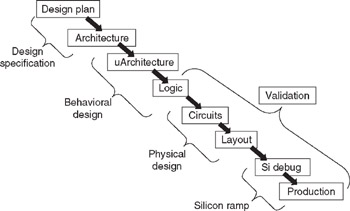
Transistor scaling and growing transistor budgets have allowed microprocessor performance to increase at a dramatic rate, but they have also increased the effort of microprocessor design. As more functionality is added to the processor, there is more potential for logic errors. As clock rates increase, circuit design requires more detailed simulations. The production of new fabrication generations is inevitably more complex than previous generations. Because of the short lifetime of most microprocessors in the marketplace, all of this must happen under the pressure of an unforgiving schedule. The general steps in processor design are shown in Fig. 3-1.
A microprocessor, like any product, must begin with a plan, and the plan must include not only a concept of what the product will be, but also how it will be created. The concept would need to include the type of applications to...