Modern Optical Engineering: The Design of Optical Systems, Fourth Edition
Chapter 1: Optics Overview

1.1 The Electromagnetic Spectrum

This book deals with certain phenomena associated with a relatively narrow slice of the electromagnetic spectrum. Optics is often defined as being concerned with radiation visible to the human eye; however, in view of the expansion of optical applications in the regions of the spectrum on either side of the visible region, it seems not only prudent, but necessary, to include certain aspects of the infrared and ultraviolet regions in our discussions.

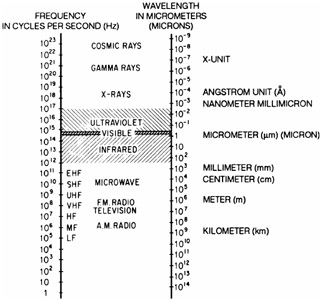
The known electromagnetic spectrum is diagramed in Fig. 1.1 and ranges from cosmic rays to radio waves. All the electromagnetic radiations transport energy and all have a common velocity in vacuum of c = 2.998 10 10 cm/s. In other respects, however, the nature of the radiation varies widely, as might be expected from the tremendous range of wavelengths represented. At the short end of the spectrum, we find gamma radiation with wavelengths extending below a billionth of a micron (one micron or micrometer = 1 ?m = 10 -6 m) and at the long end, radio waves with wavelengths measurable in miles. At the short end of the spectrum, electromagnetic radiation tends to be quite particle-like in its behavior, whereas toward the long wavelength end the behavior is mostly wavelike. Since the optical portion of the spectrum occupies an intermediate position, it is not surprising that optical radiation exhibits both wave and particle behavior.


Figure 1.1: The electromagnetic spectrum.

The visible portion of this spectrum (Fig. 1.2) takes...

UNLIMITED FREE
ACCESS
TO THE WORLD'S BEST IDEAS

SUBMIT
Already a GlobalSpec user? Log in.

This is embarrasing...

An error occurred while processing the form. Please try again in a few minutes.

Customize Your GlobalSpec Experience

Category: Radiation Detectors
Finish!
Privacy Policy

This is embarrasing...

An error occurred while processing the form. Please try again in a few minutes.