Modern Optical Engineering: The Design of Optical Systems, Fourth Edition
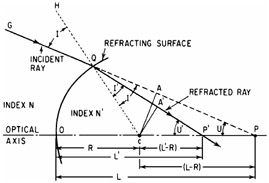
As mentioned in Chap. 1, the path of a meridional light ray through an optical system can be calculated from Snell's law (Eq. 1.3) by the application of a modest amount of geometry and trigonometry. Figure 3.1 shows a light ray ( GQP) incident on a spherical surface at point Q. The ray is directed toward point P where it would intersect the optical axis at a distance L from the surface if the ray were extended. At Q the ray is refracted by the surface and intersects the axis at P', a distance L' from the surface. The surface has a radius R with center of curvature at C and separates two media of index n on the left and index n' on the right. The light ray makes an angle U with the axis before refraction, U' after refraction; angle I is the angle between the incident ray and the normal to the surface ( HQC) at point Q, and angle I' is the angle between the refracted ray and the normal. Notice that plain or unprimed symbols are used for quantities before refraction at the surface; after refraction, the symbols are primed.
The sign conventions which we shall observe are as follows:
A radius is positive if the center of...