Modern Optical Engineering: The Design of Optical Systems, Fourth Edition

Chapter 11: Optical Coatings

11.1 Dielectric Reflection and Interference Filters

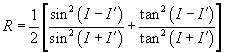
The portion of the light reflected ( Fresnel reflection) from the surface of an ordinary dielectric material (such as glass) is given by

(11.1)

where I and I' are the angles of incidence and refraction, respectively. The first term of Eq. 11.1 gives the reflection of the light which is polarized normal to the plane of incidence ( s-polarized), and the second term the reflection for the other plane of polarization ( p-polarized). As indicated in Sec. 10.1, at normal incidence Eq. 11.1 reduces to

(11.2)

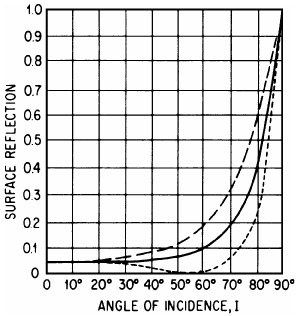
The variation of reflection from an air-glass interface as a function of the angle of incidence ( I) is shown in Fig. 11.1, where the solid line is R, the dashed line is the sine term, and the dotted line is the tangent term. Notice that the dotted line drops to zero reflectivity at Brewster's angle (Eq. 10.18).


Figure 11.1: The reflection from a single air-glass interface (for an index of 1.523). Solid line is the reflection of unpolarized light. The fine dashed line is the reflection of p-polarized light, with the electric field vector parallel to the plane of incidence. The heavier dashed line is for the s-polarization. (Note that the "plane of polarization" was originally defined to be at right angles to what we now call the plane of polarization/vibration.)

The reflection from more than one surface can be treated as indicated by Eq. 10.5 when the...

UNLIMITED FREE
ACCESS
TO THE WORLD'S BEST IDEAS

SUBMIT
Already a GlobalSpec user? Log in.

This is embarrasing...

An error occurred while processing the form. Please try again in a few minutes.

Customize Your GlobalSpec Experience

Category: Polarizing Cube Beamsplitters
Finish!
Privacy Policy

This is embarrasing...

An error occurred while processing the form. Please try again in a few minutes.